Introduction: Most PTFE GF Problems Are Process Problems
But here’s the reality most buyers don’t expect:
Switching to PTFE GF solves performance issues—but creates machining problems.
Shops that treat it like standard PTFE usually run into:
•Rapid tool wear
•Poor surface finish
•Dimensional inconsistency
•Unstable batch quality
This guide is not theoretical. It’s built around what actually goes wrong in production—and how to fix it.
Table of Contents
Material Behavior: Why PTFE GF Machines Differently
PTFE GF is not just reinforced—it behaves closer to a plastic composite than a pure polymer.
Key Material Changes vs Virgin PTFE
| Property | Virgin PTFE | PTFE GF (25%) |
| Compressive Strength | ~20–30 MPa | ~80–120 MPa |
| Wear Resistance | Low | 3–5× higher |
| Thermal Expansion | High | Reduced by ~30–50% |
| Creep Resistance | Poor | Significantly improved |
| Machinability | Easy | Moderate–Difficult |
What This Means in Machining
•Glass fibers cut your tools
•Reduced elasticity means less forgiveness
•Higher stiffness means better tolerance control—but higher stress risk

GF Content Matters: 15% vs 25% vs 40%
Not all PTFE GF behaves the same.
15% Glass Fiber
•Easier to machine
•Lower tool wear
•Moderate strength improvement
👉 Best for: general sealing parts with moderate load
25% Glass Fiber (Most Common)
•Balanced machinability vs performance
•Noticeable tool wear
•Stable dimensional behavior
👉 Best for: industrial sealing, valves, pump components
40% Glass Fiber
•Maximum strength and wear resistance
•Very abrasive
•Higher brittleness
👉 Best for: extreme pressure or wear conditions
⚠️ But: machining cost rises sharply.
Tooling Strategy: The Deciding Factor
Tool Material Selection
| Tool Type | Recommendation | Reality |
| HSS | ❌ Not recommended | Wears out extremely fast |
| Carbide | ✅ Standard choice | Balanced cost/performance |
| PCD | ⭐ Best option | Expensive but stable |
Practical Insight
•Carbide works for low-medium volume
•PCD becomes cheaper in mass production
Tool Geometry Guidelines
•Positive rake angle → reduces cutting force
•Sharp edge → prevents tearing
•Polished surface → reduces adhesion
Avoid:
•Worn tools
•Negative rake tools
•Rough-edged inserts
Tool Life Reality
Typical carbide tool life in PTFE GF:
•Light cutting: 4–8 hours effective cutting time
•Aggressive conditions: 1–3 hours
👉 If your tools last longer, you’re probably cutting too slow.
👉 If shorter, your parameters are wrong.
Cutting Parameters: Proven Working Ranges
Below are practical ranges used in real production (turning operations).
Turning Parameters (Reference)
| Parameter | Recommended Range |
| Cutting Speed | 100–300 m/min |
| Feed Rate | 0.05–0.25 mm/rev |
| Depth of Cut | 0.5–3 mm |
Milling Parameters (Reference)
| Parameter | Recommended Range |
| Cutting Speed | 150–400 m/min |
| Feed per Tooth | 0.02–0.08 mm |
| Depth of Cut | 0.5–2 mm |
Key Rule
Stable cutting beats aggressive cutting.
Most surface defects come from:
•Too slow (rubbing)
•Too fast (overheating)
Heat Management: The Hidden Killer
PTFE GF still contains a thermoplastic matrix.
What Heat Does
•Softens PTFE
•Causes smearing
•Reduces dimensional accuracy
Cooling Strategy
| Method | Recommendation |
| Dry cutting | ✅ Preferred in many cases |
| Air cooling | ✅ Highly recommended |
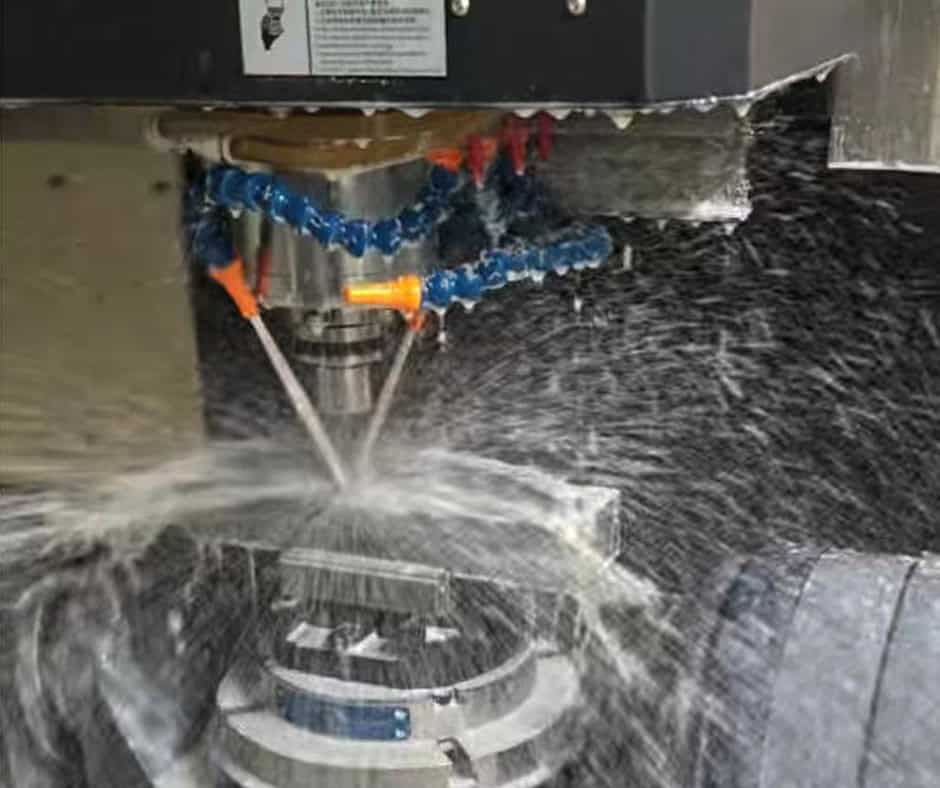
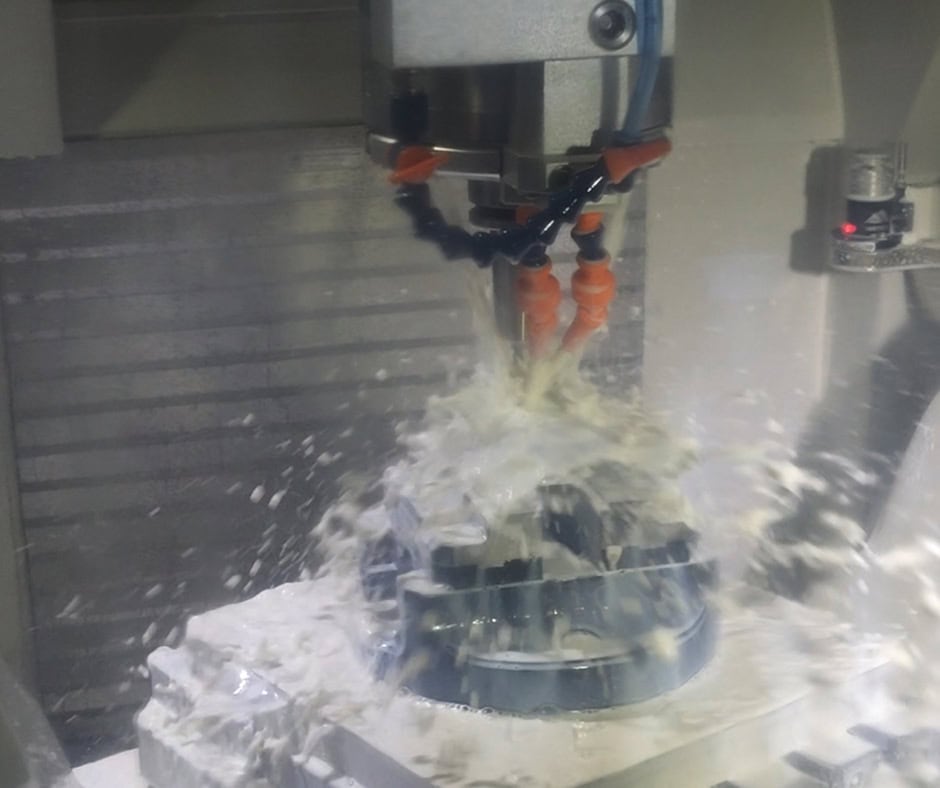
| Flood coolant | ⚠️ Use cautiously |
Too much coolant can:
•Cause uneven cooling
•Affect dimensional stability
Surface Finish: Functional, Not Cosmetic
In sealing applications, surface finish directly affects performance.
Common Surface Problems
•Fiber pull-out
•Micro tearing
•Rough sealing surfaces
Achieving Better Surface Finish
•Always use sharp tools
•Apply finishing pass with lighter feed
•Maintain constant cutting conditions
Realistic Expectation
•Mirror finish → unrealistic at high GF%
•Target → consistent Ra for sealing function
Tolerance Control: Where PTFE GF Wins
Compared to virgin PTFE:
•Less deformation
•Better repeatability
But new problems appear.
Common Issues
•Internal stress → deformation after machining
•Thin-wall instability
•Ovality in rings
Solutions
1. Machining Strategy
•Rough → semi-finish → finish
•Avoid heavy final cuts
2. Stress Relief
For critical parts:
•Annealing at controlled temperature
•Reduces post-machining distortion
3. Fixturing
•Avoid excessive clamping
•Use uniform support
Real Case Study 1: Seal Ring Leakage Problem
Problem
A customer producing high-pressure seal rings faced:
•Leakage after short use
•Rough sealing surface
Root Cause
•Tool wear ignored
•Feed rate too high
•Fiber tearing on surface
Solution
•Switched to carbide inserts with defined life cycle
•Reduced feed rate by 30%
•Added finishing pass
Result
•Surface quality stabilized
•Leakage reduced significantly
•Scrap rate dropped by over 40%
Real Case Study 2: Tool Cost Explosion
Problem
A factory used HSS tools to reduce cost.
Result:
•Tools replaced every 30–60 minutes
•Inconsistent dimensions
•High labor cost
Solution
•Switched to carbide tools
•Optimized cutting speed
Result
•Tool life increased 5×
•Overall cost reduced (despite higher tool price)
PTFE GF vs Other Materials (Machining Perspective)
| Material | Machining Difficulty | Tool Wear | Surface Finish |
| Virgin PTFE | Easy | Very low | Excellent |
| PTFE GF | Medium–Hard | High | Moderate |
| Nylon GF | Medium | Medium | Good |
| PEEK | Hard | Medium | Very good |
Key Insight
PTFE GF sits in a difficult middle ground:
Not as easy as plastics
Not as stable as engineering polymers
Common Mistakes That Kill Quality
1. Using Wrong Tools
👉 Leads to:
•Poor finish
•High scrap
2. Ignoring Tool Wear
👉 Leads to:
•Batch inconsistency
3. Overheating Material
👉 Leads to:
•Smearing
•Tolerance drift
4. Chasing Speed Over Stability
👉 Leads to:
•Unpredictable results
FAQ: What Buyers and Engineers Actually Ask
1. Is PTFE GF difficult to machine?
Yes. Compared to virgin PTFE, it is significantly harder due to glass fiber abrasiveness and reduced elasticity.
2. What is the best tool for PTFE GF?
•Carbide → standard
•PCD → best for high volume and precision
3. Why is my surface finish poor?
Most common reasons:
•Tool wear
•Incorrect feed rate
•Fiber pull-out
4. Can PTFE GF achieve tight tolerances?
Yes—better than virgin PTFE, but requires:
•Proper machining sequence
•Stress control
5. Is coolant necessary?
Not always. Air cooling or dry cutting often works better.
Cost vs Performance: The Real Equation
PTFE GF machining costs more due to:
•Tool wear
•Process control
•Lower cutting efficiency
But ignoring proper machining leads to:
•Scrap
•Rework
•Field failure
Real Industry Truth
Cheap machining is expensive.
Controlled machining is profitable.
Final Insight: PTFE GF Rewards Discipline
PTFE GF is not forgiving.
•It exposes weak tooling strategy
•It punishes unstable processes
•It demands consistency
But when done right, it delivers:
•Stable dimensions
•Reliable sealing performance
•Long service life
Conclusion
Machining PTFE GF successfully is not about pushing machines harder—it’s about controlling every variable:
•Tooling
•Parameters
•Heat
•Process sequence
If you treat it like standard PTFE, you’ll struggle.
If you treat it like a precision composite material, you’ll get predictable, high-quality results.
In PTFE GF machining, consistency is not optional—it is the process.