1. Product Overview
A Fan Mounting Bracket is a mechanical support component used to secure a cooling fan, blower, or ventilation assembly to a defined position within equipment. Although its geometry is often relatively simple, the bracket plays an important role in maintaining fan alignment, structural stability, airflow clearance, and long-term mechanical reliability.
In electronics enclosures, industrial control cabinets, telecommunications equipment, laboratory instruments, automation systems, and other machinery, a fan mounting bracket connects the rotating cooling device to the surrounding structure. It must withstand the fan’s static weight, installation loads, and vibration while keeping the fan in the intended position.
The bracket can also solve several practical installation problems:
Provides a repeatable mounting position for the fan
Maintains the required clearance around the fan
Transfers vibration and mechanical loads into the equipment frame
Allows fans to be installed where direct enclosure mounting is not possible
Accommodates different fan sizes or mounting patterns when adjustment is required
Provides a replaceable interface between the fan and the main equipment structure
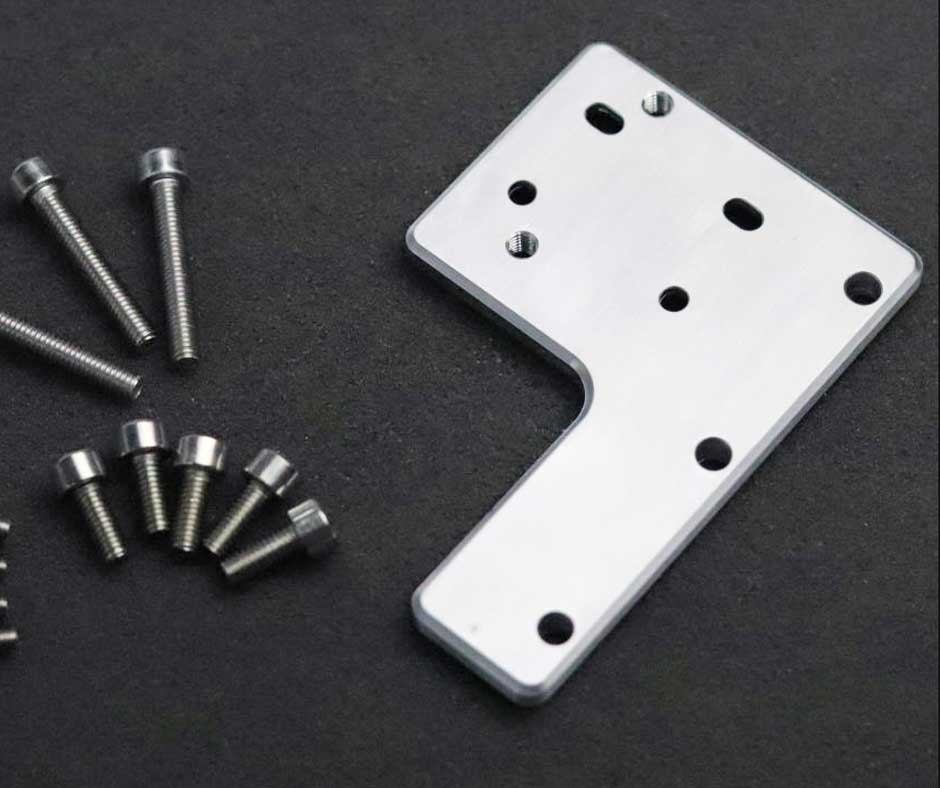
A typical fan mounting bracket may consist of a flat mounting plate, vertical support walls, mounting flanges, holes or slots, threaded holes, and reinforcement features. Depending on the application, the design may be a simple L-shaped bracket, U-shaped support, angle bracket, multi-plane frame, or more complex machined component.
Common materials include aluminum alloys, stainless steel, carbon steel, and engineering plastics. Aluminum is frequently selected when low weight and corrosion resistance are important. Stainless steel is more appropriate for demanding environments where corrosion resistance and structural durability are priorities. Carbon steel can be suitable for cost-sensitive structural applications, particularly when a protective coating is applied.
For custom equipment, a custom CNC machined fan mounting bracket can be manufactured directly from the customer’s 2D drawing or 3D CAD model, allowing mounting holes, thicknesses, interfaces, and tolerances to match the actual assembly.
Table of Contents
2. Design and Performance Considerations
The performance of a fan mounting bracket depends less on its appearance than on how effectively its geometry controls mechanical loads and positioning. Several engineering characteristics should be considered during design.
2.1 Structural Strength
The bracket must resist the static load of the fan as well as installation forces. More importantly, the structure should remain stable when exposed to continuous vibration.
A thin flat plate may be sufficient for a small electronic cooling fan, while a larger industrial fan may require thicker material, folded sections, ribs, or additional support points.
Bracket stiffness is influenced by:
Material strength and modulus
Material thickness
Overall bracket geometry
Distance between mounting points
Reinforcement ribs or gussets
Cantilever length
Increasing thickness is not always the most efficient solution. Adding a formed flange or reinforcing rib can increase stiffness while keeping weight relatively low.
2.2 Dimensional Accuracy
Fan mounting holes must correspond correctly with the fan’s mounting pattern and the surrounding equipment.
Hole position is particularly important because even a small positional error can make installation difficult when multiple holes must align simultaneously.
For custom parts, critical dimensions should therefore be identified according to the drawing rather than relying on generic machining tolerances.
2.3 Positioning and Alignment
The bracket determines the fan’s position relative to the enclosure, heat source, duct, or other components.
Correct positioning affects:
Airflow path
Fan-to-component clearance
Cable routing
Service access
Interference with adjacent components
Overall assembly alignment
For applications involving multiple fans or constrained airflow channels, positional accuracy becomes especially important.
2.4 Vibration Resistance
Fans contain rotating components and naturally generate vibration. If the mounting bracket is insufficiently rigid, vibration can cause noise, fastener loosening, fatigue, or movement of the fan assembly.
A good design considers the bracket’s stiffness, mounting configuration, fastener arrangement, and connection to the equipment frame.
In some systems, rubber isolation mounts or vibration-damping elements are used between the fan and bracket. The bracket itself does not necessarily need to absorb all vibration; instead, the mechanical interface should be designed as a complete system.
2.5 Thermal Stability
Cooling equipment is often installed near heat-generating components. The bracket may therefore experience temperature changes during operation.
Material selection and geometry should account for thermal expansion when dimensional stability is important. This becomes more significant when the bracket connects components made from different materials.
For example, an aluminum bracket attached to a steel enclosure may experience different thermal expansion behavior from the surrounding structure.
2.6 Corrosion Resistance
Environmental conditions determine whether corrosion protection is required.
Indoor electronics equipment may only require a suitable aluminum surface finish, while industrial equipment exposed to humidity, chemicals, or outdoor conditions may require stainless steel or an appropriate protective coating.
Surface treatment should be selected based on the actual operating environment rather than simply added as a cosmetic feature.
2.7 Surface Quality and Assembly Safety
Machined edges can contain sharp burrs after milling or drilling. Proper deburring is therefore important for both assembly safety and functional reliability.
A clean, burr-free surface also reduces the possibility of interference around mounting holes and mating surfaces.
3. Materials and Design Options
Material selection should balance structural requirements, weight, environment, machining cost, and appearance.
| Material | Advantages | Typical Considerations |
| Aluminum alloy | Lightweight, corrosion resistant, easy to machine | Lower stiffness than steel |
| Stainless steel | High corrosion resistance and durability | Higher material and machining cost |
| Carbon steel | Strong, economical, widely available | Usually requires surface protection |
| Engineering plastic | Lightweight, electrically insulating | Lower mechanical and thermal capability depending on grade |
Aluminum Fan Mounting Brackets
Aluminum alloys are particularly useful for equipment where weight matters. They are also relatively easy to CNC machine and can receive finishes such as anodizing.
A CNC machined aluminum fan mounting bracket can provide a good combination of stiffness, weight, machinability, and corrosion resistance.
Stainless Steel Brackets
Stainless steel is appropriate for environments where corrosion resistance and mechanical durability are important. The trade-off is that stainless steel generally requires more machining effort than aluminum.
Fixed vs. Adjustable Designs
A fixed bracket is preferable when the fan size and mounting position are known. It normally has lower part complexity and can be economical for volume production.
An adjustable fan mounting bracket may incorporate slots or multiple mounting positions. This allows one bracket to accommodate different fan positions or mounting patterns.
The disadvantage is that slots and adjustment mechanisms can increase manufacturing time and may reduce positional rigidity if the design is not properly engineered.
Standard vs. Custom Designs
A standard bracket can be suitable for common equipment configurations. A custom bracket becomes more practical when the available installation space, hole pattern, fan orientation, or airflow requirements are unique.
For OEM equipment, customization is often necessary because the bracket must interface with several surrounding components simultaneously.
4. Manufacturing and CNC Machining
Fan mounting brackets can be manufactured using sheet metal fabrication, stamping, bending, injection molding, or CNC machining depending on geometry, material, quantity, and required accuracy.
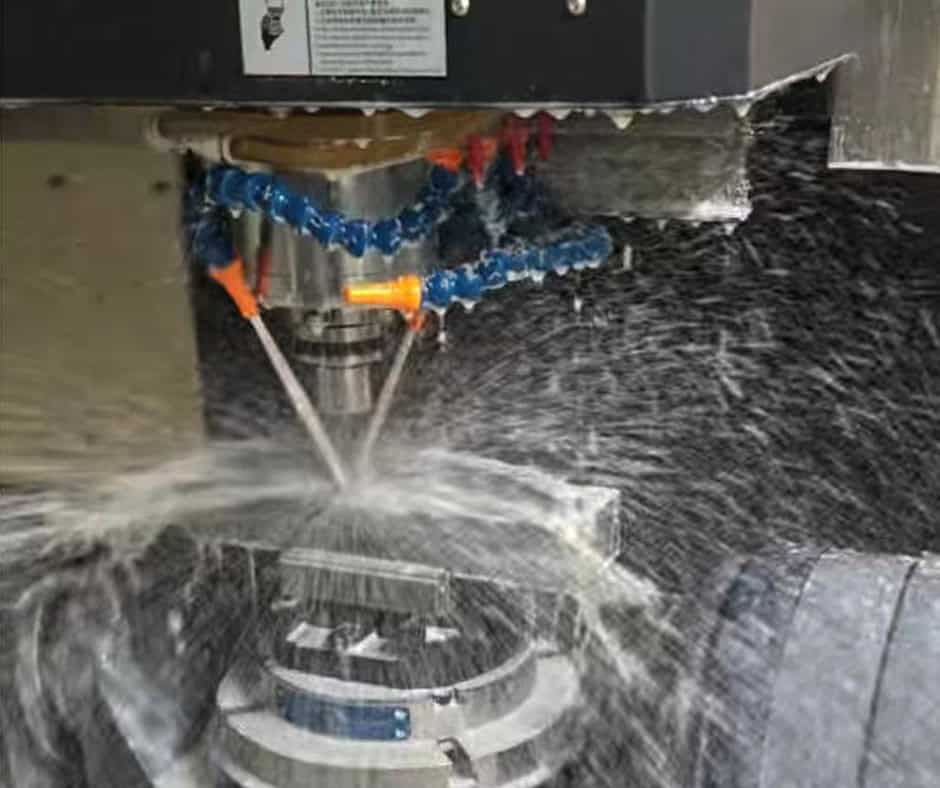
CNC machining is particularly useful when the bracket has machined pockets, precise mounting interfaces, threaded holes, complex contours, or relatively low production quantities.
CNC Milling
CNC milling can produce:
Mounting faces
Pockets
Slots
Holes
Threaded holes
Recesses
Reinforcement geometry
Complex external profiles
For a custom CNC fan bracket, the machining strategy should be developed around the functional surfaces and required tolerances.
Drilling, Tapping, and Reaming
Mounting holes are often among the most important features.
Drilling creates the basic hole, while tapping produces internal threads when the fan or bracket is fastened directly with threaded hardware. Reaming may be used when a tighter hole diameter or improved positional consistency is required.
Multi-Axis Machining
A multi-axis CNC machine can be useful when several faces need to be machined accurately or when the bracket contains complex three-dimensional geometry.
However, multi-axis machining should be used because the geometry requires it—not simply because it is available. For simpler brackets, three-axis machining may be more economical.
Deburring and Cleaning
After machining, burrs around holes and edges should be removed. Parts should also be cleaned to eliminate machining chips, coolant residue, and other contaminants.
This is particularly important for components installed inside sensitive electronic or optical equipment.
Surface Treatment
Depending on material and requirements, surface treatments may include:
Anodizing
Powder coating
Plating
Passivation
Painting
The treatment should be compatible with dimensional requirements. For example, coatings applied to threaded or close-fitting surfaces can affect final fit if not accounted for during manufacturing.
5. Typical Manufacturing Challenges
Although a fan mounting bracket may appear straightforward, several manufacturing issues can affect its final performance.
5.1 Maintaining Hole Position
When multiple mounting holes must align with a fan and an equipment frame, positional errors can accumulate.
Solution: Establish the primary datum surfaces and machine critical holes using a controlled setup. Where appropriate, inspection fixtures or coordinate measurement can verify the hole pattern.
5.2 Controlling Thin-Wall Deflection
A lightweight bracket may contain thin sections that can deform during machining.
Solution: Select appropriate workholding, cutting conditions, toolpaths, and machining sequences. Where the design permits, temporary support or additional stock can also help control deformation.
5.3 Machining Internal Corners
CNC milling tools are round, so internal corners generally cannot be perfectly sharp unless special processes are used.
Solution: Specify realistic internal radii based on the selected cutter. If a sharp corner is functionally necessary, the design may require a secondary process.
5.4 Burrs Around Small Holes and Slots
Small drilled or milled features can produce burrs, particularly when machining ductile materials such as aluminum.
Solution: Apply controlled deburring and edge finishing while ensuring that critical dimensions are not altered.
5.5 Maintaining Flatness
The bracket may need to sit against another mounting surface. Uneven machining or residual stress can cause distortion.
Solution: Use suitable workholding and machining sequences, and inspect critical flatness, parallelism, or perpendicularity according to the drawing.
6. Quality Control
A fan mounting bracket should be inspected according to its actual engineering requirements. There is no single universal dimensional specification that applies to every bracket.
Important inspection characteristics may include:
Overall dimensions
Material verification
Hole diameter
Hole position
Thread dimensions
Flatness
Parallelism
Perpendicularity
Surface finish
Edge condition
Functional fit
For relatively simple parts, calibrated measuring instruments may be sufficient. More complex brackets with several datum relationships may require a CMM inspection to verify the relationship between critical features.
Inspection should focus on functional characteristics rather than measuring every dimension to an unnecessarily tight tolerance.
For OEM production, the inspection plan should be based on the customer’s drawing, CAD model, tolerance requirements, and quality documentation.
7. Applications
Electronics and Control Cabinets
Fan mounting brackets are commonly used inside control cabinets and electronic enclosures to position cooling fans near heat-generating components.
Custom dimensions can be important because internal cabinet space is often limited.
Telecommunications Equipment
Telecommunications systems can contain multiple heat-producing electronic modules. Brackets help position cooling fans within restricted equipment frames while maintaining airflow clearance.
Industrial Automation
Automation controllers, drives, power supplies, and control systems may require forced-air cooling. A robust bracket provides a repeatable mechanical interface for the cooling assembly.
Laser and Optical Equipment
Laser systems can generate substantial heat while requiring carefully controlled internal layouts. A custom fan mounting bracket can position cooling hardware without interfering with optical assemblies, cables, or other sensitive components.
Medical and Laboratory Equipment
Laboratory instruments and medical equipment may have compact internal architectures. In these applications, material choice, clean finishing, dimensional consistency, and controlled assembly can be important.
Industrial Machinery
Larger fans and blowers used for equipment cooling may require reinforced brackets capable of supporting greater loads and resisting continuous vibration.
8. Fan Mounting Bracket vs. Fan Guard
A fan mounting bracket and a fan guard can both be installed around a cooling fan, but they perform different functions.
| Factor | Fan Mounting Bracket | Fan Guard |
| Primary function | Supports and positions the fan | Protects people and equipment from rotating blades |
| Structural role | Usually load-bearing | Usually protective |
| Mounting | Connects fan to equipment structure | Covers or surrounds the fan |
| Design priority | Alignment and rigidity | Safety and airflow protection |
| Manufacturing | Machining, sheet metal, or formed construction | Often wire forming, stamping, or molded construction |
| Typical cost | Depends heavily on geometry and machining | Often lower for standardized designs |
Choose a Fan Mounting Bracket when the primary requirement is to position and structurally secure a fan within equipment.
Choose a fan guard when the primary concern is preventing accidental contact with rotating components or protecting the fan from external objects.
In some systems, both components are required.
9. Cost and Procurement Considerations
The price of a custom fan mounting bracket is determined by the complete manufacturing specification rather than material alone.
Major cost factors include:
Material
Aluminum may provide economical machining for many applications, while stainless steel or specialty materials can increase material and processing costs.
Geometry
Simple plates and brackets generally require fewer machining operations. Pockets, ribs, curved surfaces, multiple setups, and complex profiles increase machining time.
Tolerance
Tight tolerances require more controlled machining and inspection. Buyers should avoid specifying unnecessarily tight tolerances on non-functional features.
Quantity
Production volume has a significant effect on unit cost. Tooling, programming, setup, inspection, and purchasing costs can be distributed across more parts as quantity increases.
Machining Time
Material removal volume, number of operations, tool changes, and workholding requirements all influence machining cost.
Surface Treatment
Anodizing, powder coating, plating, passivation, and other finishing operations add processing and logistics costs.
Inspection Requirements
Standard dimensional inspection is different from detailed CMM inspection, material certification, or additional quality documentation. The required level should match the application’s risk.
10. Prototype, Low-Volume, OEM, and Production Requirements
Different purchasing stages require different manufacturing approaches.
Prototype:
The priority is usually design verification and fast iteration. CNC machining is well suited to prototypes because no dedicated production tooling is normally required.
Low-volume production:
Small batches can use CNC machining when flexibility is more valuable than tooling investment.
OEM production:
OEM customers generally require stable dimensions, repeatable processes, controlled materials, and consistent finishing across batches.
Production volume:
For larger quantities, manufacturers may evaluate CNC machining against sheet metal fabrication, stamping, casting, or other production methods to determine the most economical process.
The best manufacturing process therefore depends on both part geometry and expected annual volume.
11. Customization and Quotation
A custom fan mounting bracket can be adapted to the equipment rather than forcing the equipment to accommodate a standard bracket.
Potential customization includes:
Overall dimensions
Material and thickness
Fan mounting pattern
Hole diameter and thread type
Slot dimensions
Mounting flange geometry
Reinforcement features
Surface finish
Surface treatment
Engraving or identification marks
Special dimensional tolerances
For an accurate quotation, buyers should normally provide:
2D engineering drawing
3D CAD file
Material specification
Required quantity
Critical tolerances
Surface finish requirements
Surface treatment
Inspection requirements
Packaging requirements, when applicable
A STEP file can help manufacturers understand the three-dimensional geometry, while a 2D drawing is generally important for defining tolerances, materials, threads, finishes, and other manufacturing requirements.
The more complete the engineering information, the less uncertainty there is during quotation and production planning.
12. FAQs
What is a Fan Mounting Bracket used for?
A Fan Mounting Bracket secures and positions a cooling fan within equipment. It provides a stable mechanical interface while maintaining the required alignment and clearance.
What material is best for a Fan Mounting Bracket?
There is no universal best material. Aluminum is often suitable when low weight and machinability are important, while stainless steel may be preferred for demanding environments. The correct choice depends on load, temperature, corrosion exposure, and equipment requirements.
Can a Fan Mounting Bracket be CNC machined?
Yes. CNC machining is suitable for custom brackets with precise holes, threaded features, pockets, mounting surfaces, or complex geometries. Sheet metal fabrication may be more economical for certain high-volume or formed designs.
How precise does a custom fan bracket need to be?
The required precision depends on the functional interfaces. Hole position, mounting surfaces, and critical alignment features may require tighter tolerances than non-functional external dimensions. Final requirements should follow the engineering drawing.
Can the bracket be customized for different fan sizes?
Yes. A custom design can accommodate different fan dimensions, mounting patterns, hole spacing, thicknesses, and installation constraints. Adjustable slots can also be incorporated when multiple mounting positions are required.
What information should I provide when requesting a quotation?
A 2D drawing and 3D CAD file are the most useful starting points. Material, quantity, tolerances, surface treatment, surface finish, and inspection requirements should also be specified whenever applicable.
13. Conclusion
A Fan Mounting Bracket is a relatively small component, but its mechanical role can have a direct effect on the stability and reliability of a cooling system. The bracket must provide adequate structural support while maintaining fan position, mounting accuracy, clearance, and resistance to vibration.
The most appropriate design depends on the equipment architecture. A simple fixed aluminum bracket may be sufficient for a compact electronic enclosure, while a reinforced stainless steel design may be more appropriate for a demanding industrial environment.
From a manufacturing perspective, successful production depends on more than simply machining the bracket to its nominal dimensions. Hole position, flatness, workholding, burr control, surface treatment, and inspection strategy can all influence the final assembly.
For engineers and procurement teams, the most effective approach is to define the functional requirements first and then select the material, geometry, machining process, tolerances, and finishing method accordingly. When the bracket is designed around the actual equipment interface and manufactured according to the customer’s drawing, it can provide a reliable and repeatable solution for fan installation across prototypes, low-volume assemblies, and OEM production.